Buying Guide for the Best Spotting Scope For Phone
Choosing the right spotting scope for your phone can greatly enhance your outdoor adventures, whether you're birdwatching, hunting, or simply enjoying nature. A spotting scope allows you to see distant objects with clarity and detail, and when paired with your phone, it can capture stunning photos and videos. To make the best choice, you need to consider several key specifications that will determine the performance and compatibility of the spotting scope with your phone. Here are the most important specs to look at and how to choose the right one for your needs.MagnificationMagnification refers to how much closer the object will appear through the spotting scope compared to the naked eye. This is important because higher magnification allows you to see more detail. Spotting scopes typically offer magnification ranges from 15x to 60x. For general use, a magnification of 20x to 40x is usually sufficient, providing a good balance between detail and stability. Higher magnifications, like 50x or 60x, are great for long-distance viewing but can be harder to stabilize and may require a tripod.
Objective Lens DiameterThe objective lens diameter is the size of the front lens of the spotting scope, measured in millimeters. This spec is crucial because a larger objective lens allows more light to enter the scope, resulting in brighter and clearer images, especially in low-light conditions. Common sizes range from 50mm to 100mm. For most users, a 60mm to 80mm lens provides a good balance of brightness and portability. If you plan to use the scope in very low light or want the brightest possible image, consider a larger lens, but keep in mind that it will be bulkier and heavier.
Field of ViewField of view (FOV) is the width of the area you can see through the spotting scope at a specific distance, usually measured in feet at 1,000 yards. A wider FOV makes it easier to locate and track moving objects, which is particularly useful for birdwatching or observing wildlife. Spotting scopes with a lower magnification typically offer a wider FOV. If you need to follow fast-moving subjects or scan large areas, look for a scope with a wider FOV. For detailed observation of stationary objects, a narrower FOV with higher magnification might be more suitable.
Eye ReliefEye relief is the distance from the eyepiece to your eye where you can still see the full field of view. This is especially important for eyeglass wearers, as insufficient eye relief can make it difficult to see the entire image. Eye relief typically ranges from 12mm to 20mm. If you wear glasses, look for a spotting scope with at least 15mm of eye relief to ensure comfortable viewing. For those without glasses, shorter eye relief may be acceptable, but longer eye relief can still provide a more comfortable experience.
Lens CoatingLens coating refers to the special coatings applied to the lenses to reduce glare and improve light transmission, resulting in clearer and brighter images. There are different levels of coating: single-coated, fully-coated, multi-coated, and fully multi-coated. Fully multi-coated lenses offer the best performance, providing the highest light transmission and the clearest images. If image quality is a priority, opt for fully multi-coated lenses. For casual use, fully-coated or multi-coated lenses can still provide good performance at a lower cost.
Waterproof and FogproofWaterproof and fogproof features ensure that your spotting scope can withstand harsh weather conditions and prevent internal fogging caused by temperature changes. These features are important if you plan to use the scope in various outdoor environments. Look for scopes that are nitrogen or argon purged and have O-ring seals to ensure they are fully waterproof and fogproof. If you will be using the scope in wet or humid conditions, these features are essential to maintain clear and reliable performance.
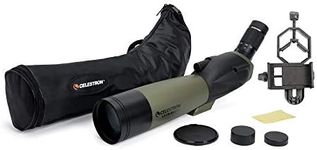
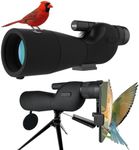
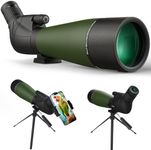
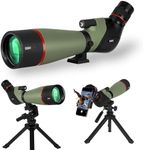
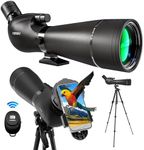
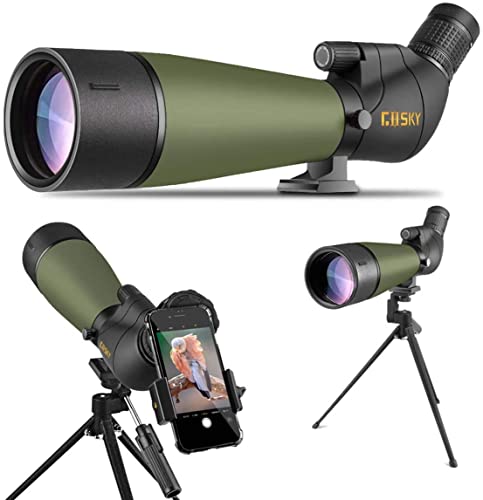
Phone Adapter CompatibilityPhone adapter compatibility refers to the ability of the spotting scope to connect with your smartphone for taking photos and videos. This is crucial if you want to capture and share your observations. Some spotting scopes come with a phone adapter included, while others require you to purchase one separately. Ensure that the adapter is compatible with your specific phone model and that it securely attaches to the scope. If you frequently use your phone for photography, a scope with a high-quality, easy-to-use adapter will enhance your experience.