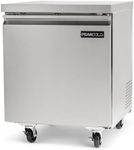
Buying Guide for the Best Under Counter Freezers
When choosing an under-counter freezer, it's important to consider your specific needs and the space where the freezer will be placed. Under-counter freezers are great for maximizing storage in smaller kitchens or for adding extra freezing capacity in larger kitchens. To make the best choice, you should look at several key specifications that will help you determine which model is right for you. Understanding these specs will ensure that you get a freezer that fits your space, meets your storage needs, and operates efficiently.Size and CapacitySize and capacity refer to the physical dimensions of the freezer and how much it can hold. This is important because you need to ensure the freezer fits in the designated space under your counter and provides enough storage for your needs. Sizes can vary, with widths typically ranging from 20 to 24 inches. Capacity is usually measured in cubic feet, with smaller models offering around 3 cubic feet and larger ones up to 5 cubic feet or more. To pick the right one, measure the space where you plan to install the freezer and consider how much frozen food you typically store.
Energy EfficiencyEnergy efficiency indicates how much electricity the freezer uses to operate. This is important for both environmental reasons and to keep your utility bills low. Energy-efficient models are often labeled with an Energy Star rating. Freezers with higher energy efficiency will use less power, which is beneficial in the long run. To choose the right one, look for models with the Energy Star label and compare their annual energy consumption, usually listed in kilowatt-hours (kWh).
Temperature ControlTemperature control refers to the ability to set and maintain the desired temperature inside the freezer. This is crucial for keeping your food at the right freezing point to ensure it stays fresh and safe to eat. Some freezers offer manual dials, while others have digital controls for more precise settings. To pick the right one, consider how important precise temperature control is for your needs. If you store a variety of items that require different temperatures, a model with digital controls might be more suitable.
Defrosting MethodDefrosting method refers to how the freezer handles the buildup of frost. There are two main types: manual defrost and automatic (frost-free) defrost. Manual defrost freezers require you to periodically turn off the freezer and remove the frost, which can be time-consuming but often results in better energy efficiency. Automatic defrost freezers prevent frost buildup by periodically warming the interior to melt any ice, which is more convenient but can use more energy. To choose the right one, consider how much maintenance you're willing to do and whether convenience or energy savings is more important to you.
Noise LevelNoise level refers to how loud the freezer is when it's operating. This is important if the freezer will be placed in a living area or near bedrooms where noise could be disruptive. Noise levels are usually measured in decibels (dB), with lower numbers indicating quieter operation. To pick the right one, look for models that specify their noise level and choose one that fits your tolerance for noise. Generally, freezers with noise levels below 40 dB are considered quiet.
Shelving and Storage OptionsShelving and storage options refer to the internal layout of the freezer, including the number and type of shelves, drawers, and compartments. This is important for organizing your frozen items and making the most of the available space. Some freezers have adjustable shelves and door bins, which can be useful for storing larger items or organizing food more efficiently. To pick the right one, think about the types of items you typically freeze and how you prefer to organize them. Models with flexible storage options can offer more convenience and better use of space.