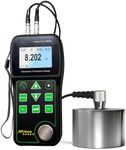
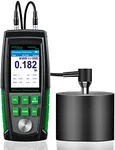
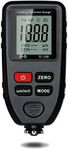
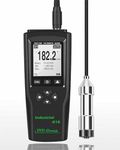
Buying Guide for the Best Thickness Gauge
Choosing the right thickness gauge can be crucial for ensuring the quality and integrity of materials in various applications. A thickness gauge is a device used to measure the thickness of a material, which can be essential in industries such as manufacturing, automotive, and construction. When selecting a thickness gauge, it's important to consider the specific needs of your application, the type of materials you will be measuring, and the level of precision required. Understanding the key specifications will help you make an informed decision and select the best thickness gauge for your needs.Measurement RangeThe measurement range of a thickness gauge indicates the minimum and maximum thicknesses it can measure. This spec is important because it determines the versatility of the gauge in different applications. If you are working with a variety of materials with different thicknesses, you will need a gauge with a wide measurement range. For example, a range of 0-10 mm might be suitable for thin materials like paper or plastic, while a range of 0-100 mm would be better for thicker materials like metal or wood. Choose a measurement range that covers the thicknesses of the materials you commonly work with.
AccuracyAccuracy refers to how close the gauge's measurements are to the actual thickness of the material. This spec is crucial for applications where precision is important, such as quality control in manufacturing. Accuracy is usually expressed in millimeters or micrometers. High-accuracy gauges can measure thickness with a precision of ±0.01 mm or better, which is ideal for critical applications. For less critical applications, a gauge with an accuracy of ±0.1 mm might be sufficient. Consider the level of precision required for your work when choosing a thickness gauge.
ResolutionResolution is the smallest increment that the gauge can detect and display. This spec is important because it affects the gauge's ability to provide detailed measurements. A higher resolution means the gauge can detect smaller changes in thickness, which is useful for applications requiring fine measurements. For example, a resolution of 0.01 mm is suitable for high-precision tasks, while a resolution of 0.1 mm might be adequate for general purposes. Choose a resolution that matches the level of detail needed for your measurements.
Material CompatibilityMaterial compatibility refers to the types of materials the thickness gauge can measure accurately. Some gauges are designed for specific materials, such as metals, plastics, or coatings, while others are more versatile and can measure a variety of materials. This spec is important because using a gauge that is not compatible with your material can result in inaccurate measurements. If you work with multiple types of materials, look for a gauge that offers broad compatibility. If you only measure one type of material, choose a gauge specifically designed for that material.
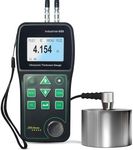
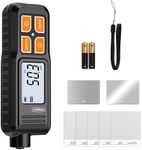
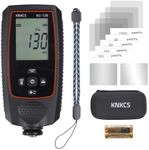
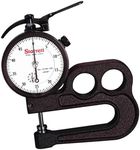
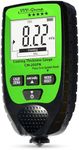
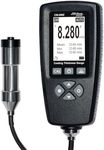
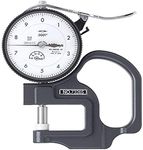
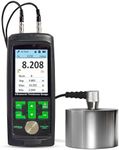
Display TypeThe display type of a thickness gauge can affect how easy it is to read and interpret measurements. Common display types include digital and analog. Digital displays provide clear, easy-to-read measurements and often include additional features like data storage and transfer. Analog displays, while less common, can be simpler and more durable in certain environments. Consider your preference and the conditions in which you will be using the gauge when choosing a display type. Digital displays are generally more user-friendly and offer more features, while analog displays can be more robust.
PortabilityPortability refers to the ease with which the thickness gauge can be transported and used in different locations. This spec is important for fieldwork or applications where the gauge needs to be moved frequently. Portable gauges are typically lightweight, compact, and battery-operated, making them convenient for on-the-go measurements. If you need to measure thickness in various locations, choose a portable gauge. For stationary applications, a larger, more robust gauge might be suitable.
Data Storage and ConnectivityData storage and connectivity features allow you to save and transfer measurement data from the thickness gauge to other devices, such as computers or smartphones. This spec is important for applications that require detailed record-keeping and analysis. Some gauges come with built-in memory, USB ports, or wireless connectivity options like Bluetooth. If you need to store and analyze measurement data, look for a gauge with these features. For simple, occasional measurements, data storage and connectivity might not be necessary.