Buying Guide for the Best Strobe Flash For Photography
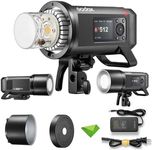
Choosing the right strobe flash for photography can significantly enhance your photos by providing the necessary lighting to capture clear and vibrant images. When selecting a strobe flash, it's important to consider several key specifications that will determine how well the flash meets your needs. Understanding these specs will help you make an informed decision and ensure that you get the best fit for your photography style and requirements.Power OutputPower output, measured in watt-seconds (Ws), indicates the strength of the flash. Higher power output means the flash can produce more light, which is useful for illuminating larger areas or shooting in bright conditions. For studio photography or shooting in large spaces, a higher power output (around 300-600Ws) is ideal. For smaller spaces or on-the-go photography, a lower power output (100-300Ws) may suffice. Consider your typical shooting environment to determine the appropriate power output for your needs.
Recycle TimeRecycle time is the duration it takes for the flash to recharge between shots. A shorter recycle time allows for quicker consecutive shots, which is crucial for capturing fast-moving subjects or working in dynamic environments. Recycle times can range from less than a second to several seconds. If you often shoot events, sports, or action photography, look for a strobe flash with a recycle time of 1 second or less. For more controlled environments like studio photography, a slightly longer recycle time may be acceptable.
Flash DurationFlash duration refers to the length of time the flash emits light, typically measured in milliseconds. Shorter flash durations can freeze motion more effectively, which is important for capturing sharp images of fast-moving subjects. Flash durations can vary from 1/1000th of a second to 1/30,000th of a second. If you frequently photograph subjects in motion, such as sports or wildlife, opt for a strobe flash with a shorter flash duration. For still subjects or slower-paced photography, a longer flash duration may be adequate.
Color TemperatureColor temperature, measured in Kelvin (K), describes the color of the light emitted by the flash. A consistent color temperature ensures that your photos have uniform lighting and accurate colors. Most strobe flashes have a color temperature around 5500K, which mimics daylight. If you need to match other light sources or achieve a specific look, consider a strobe flash with adjustable color temperature. For general photography, a fixed color temperature around 5500K is usually sufficient.
PortabilityPortability refers to the ease with which you can transport and set up the strobe flash. This includes the size, weight, and power source of the flash. Portable strobe flashes are ideal for photographers who frequently shoot on location or need to move their equipment often. Battery-powered flashes offer greater flexibility compared to those that require a power outlet. If you primarily shoot in a studio, portability may be less of a concern, and you can opt for larger, more powerful units.
CompatibilityCompatibility ensures that the strobe flash works seamlessly with your camera and other equipment. This includes the type of mount, triggering system, and any additional features like TTL (Through-The-Lens) metering. Check that the strobe flash is compatible with your camera brand and model, as well as any existing triggers or modifiers you use. For a hassle-free experience, choose a strobe flash that integrates well with your current setup and supports any advanced features you require.