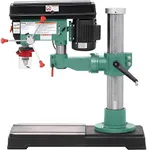
Buying Guide for the Best Standing Drill Press
Choosing the right standing drill press can make a significant difference in the quality and efficiency of your work. A standing drill press is a versatile tool used for drilling precise holes in various materials such as wood, metal, and plastic. When selecting a drill press, it's important to consider several key specifications to ensure it meets your needs and provides the best performance for your projects.Drill Press SizeThe size of a drill press is determined by the distance from the center of the chuck to the column, which is then doubled. This measurement is known as the 'swing.' A larger swing allows you to work on bigger pieces of material. For small to medium projects, a 10-12 inch drill press is usually sufficient. For larger projects, consider a 15-20 inch drill press. Choose a size that matches the scale of your typical projects.
Motor PowerMotor power is measured in horsepower (HP) and determines how much force the drill press can apply. More powerful motors can handle tougher materials and larger bits. For light-duty tasks, a 1/3 to 1/2 HP motor is adequate. For more demanding tasks, such as drilling through metal or hardwood, a 3/4 to 1 HP motor is recommended. Consider the materials you will be working with to choose the appropriate motor power.
Speed SettingsSpeed settings refer to the number of revolutions per minute (RPM) the drill press can achieve. Variable speed settings allow you to adjust the RPM to match the material and bit size, which is crucial for precision and preventing damage. Lower speeds (500-1000 RPM) are ideal for metal, while higher speeds (2000-3000 RPM) are better for wood and plastic. Look for a drill press with a wide range of speed settings to accommodate different materials and tasks.
Table Size and AdjustabilityThe table size and its adjustability are important for supporting your workpiece and ensuring accurate drilling. A larger table provides more support for bigger projects. Additionally, an adjustable table that can tilt and move up or down allows for more versatility and precision in your work. Consider the size of your typical workpieces and the need for adjustability when choosing a drill press.
Chuck SizeThe chuck size determines the maximum diameter of the drill bit that the drill press can hold. Common chuck sizes are 1/2 inch and 5/8 inch. A larger chuck size allows for the use of bigger drill bits, which is useful for larger holes. If you frequently need to drill large holes, opt for a drill press with a larger chuck size. For general use, a 1/2 inch chuck is usually sufficient.
Depth StopA depth stop is a feature that allows you to set a specific depth for your drilling, ensuring consistent hole depths. This is particularly useful for repetitive tasks where precision is key. If you need to drill multiple holes to the same depth, a depth stop can save time and improve accuracy. Look for a drill press with an easy-to-use and reliable depth stop mechanism.
Build Quality and StabilityThe build quality and stability of a drill press affect its durability and performance. A sturdy, well-built drill press will provide more accurate drilling and last longer. Look for a drill press with a solid base and column, as well as high-quality materials. Stability is crucial to prevent wobbling and ensure precise drilling. Consider the overall construction and materials used when evaluating the build quality.