Buying Guide for the Best Solar Wireless Security Camera
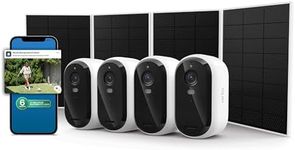
Choosing the right solar wireless security camera involves understanding your specific needs and the key features that will best meet those needs. Solar wireless security cameras are great for providing security in areas where running electrical wires is difficult or impossible. They are powered by solar panels, making them eco-friendly and cost-effective in the long run. Here are the key specifications you should consider when selecting a solar wireless security camera and how to navigate them to find the best fit for you.Solar Panel EfficiencySolar panel efficiency refers to how well the solar panel converts sunlight into electrical energy. This is important because higher efficiency means the camera can operate longer and more reliably, especially in areas with less sunlight. Efficiency is usually measured in percentage. Panels with 15-20% efficiency are common and generally sufficient for most needs. If you live in an area with limited sunlight, opt for higher efficiency panels to ensure your camera remains powered.
Battery CapacityBattery capacity determines how long the camera can operate without sunlight. This is crucial for ensuring continuous operation during cloudy days or at night. Battery capacity is measured in milliampere-hours (mAh). A higher mAh rating means a longer battery life. For general use, a battery capacity of around 5000-10000 mAh is usually adequate. If you need the camera to operate for extended periods without sunlight, look for higher capacity batteries.
Camera ResolutionCamera resolution indicates the clarity and detail of the video footage. Higher resolution provides clearer images, which can be important for identifying faces or license plates. Resolution is measured in pixels, with common options being 720p, 1080p, and 4K. For most home security needs, 1080p is sufficient. If you need very detailed footage, such as for a business or high-security area, consider a 4K camera.
Field of ViewField of view (FOV) describes the width of the area the camera can capture. A wider FOV means the camera can cover more area, which is useful for monitoring large spaces. FOV is measured in degrees. Cameras with a FOV of 90-120 degrees are common and suitable for most residential properties. For larger areas, such as parking lots or wide yards, look for cameras with a FOV of 130 degrees or more.
Night VisionNight vision capability allows the camera to capture clear footage in low light or complete darkness. This is essential for 24/7 security monitoring. Night vision is typically measured by the distance it can cover, in feet or meters. For general home security, a night vision range of 30-50 feet is usually sufficient. If you need to monitor larger areas at night, look for cameras with a longer night vision range.
Motion DetectionMotion detection helps the camera to start recording or send alerts when movement is detected. This feature is important for conserving battery life and storage space, as well as for timely notifications of potential security breaches. Motion detection sensitivity can often be adjusted. For general use, a camera with adjustable sensitivity settings is ideal, allowing you to fine-tune it to avoid false alarms from pets or other non-threatening movements.
Storage OptionsStorage options determine where and how the video footage is saved. Common options include local storage (SD cards) and cloud storage. Local storage is cost-effective and provides quick access to footage, but can be limited in capacity. Cloud storage offers more space and remote access but may require a subscription. Choose local storage if you prefer no ongoing costs and have manageable storage needs. Opt for cloud storage if you need more space and the convenience of accessing footage from anywhere.
ConnectivityConnectivity refers to how the camera communicates with your devices, typically via Wi-Fi. Reliable connectivity is crucial for real-time monitoring and receiving alerts. Cameras usually support 2.4 GHz Wi-Fi, which offers good range and compatibility. Some models also support 5 GHz Wi-Fi, which can provide faster speeds but shorter range. Ensure your camera is compatible with your home network and consider dual-band support if you need both range and speed.
Weather ResistanceWeather resistance ensures the camera can withstand various environmental conditions, such as rain, snow, and extreme temperatures. This is important for outdoor cameras to ensure durability and reliable operation. Weather resistance is often indicated by an IP rating, such as IP65 or IP67. For most outdoor environments, an IP65 rating is sufficient, providing protection against dust and water jets. For harsher conditions, consider an IP67 rating, which offers protection against immersion in water.