Buying Guide for the Best Pedalboard Power Supply
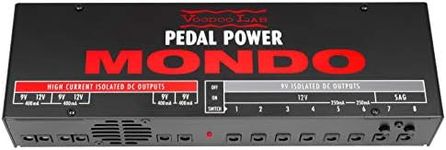
Choosing the right pedalboard power supply is crucial for any guitarist or bassist who uses multiple effects pedals. A good power supply ensures that your pedals receive consistent and clean power, which can significantly impact your overall sound quality and performance reliability. When selecting a power supply, consider the number of pedals you have, their power requirements, and the type of power supply that best suits your setup. Here are some key specifications to consider when making your choice:Output VoltageOutput voltage refers to the amount of electrical potential the power supply provides to your pedals. Most pedals require 9V, but some may need 12V, 18V, or even 24V. It's important to match the voltage requirements of your pedals to avoid damaging them. If you have a mix of pedals with different voltage needs, look for a power supply with multiple output voltages.
Current (mA)Current, measured in milliamps (mA), indicates how much electrical current the power supply can deliver. Each pedal has a specific current draw, and it's essential to ensure that the power supply can provide enough current for all your pedals combined. Add up the current requirements of all your pedals and choose a power supply that can handle at least that total amount, with some extra headroom for safety.
Isolated OutputsIsolated outputs mean that each output on the power supply is electrically separated from the others. This helps prevent ground loops and noise, which can interfere with your sound. If you have a lot of pedals or experience noise issues, a power supply with isolated outputs is a good choice. Non-isolated outputs are generally cheaper but may introduce noise, especially with digital pedals.
Size and Form FactorThe size and form factor of the power supply are important for fitting it onto your pedalboard. Consider the layout of your pedalboard and the space available. Some power supplies are compact and can fit underneath the pedalboard, while others are larger and may need to be placed on top. Choose a power supply that fits well with your pedalboard setup and doesn't take up too much space.
Number of OutputsThe number of outputs determines how many pedals you can power simultaneously. Count the number of pedals you have and choose a power supply with at least that many outputs. It's also a good idea to have a few extra outputs for future pedal additions. Some power supplies offer daisy chain options, but isolated outputs are generally preferred for better performance.
AC vs. DCPedals can require either AC (alternating current) or DC (direct current) power. Most pedals use DC, but some, especially older or more specialized pedals, may require AC. Check the power requirements of your pedals and choose a power supply that can provide the correct type of current. Some power supplies offer both AC and DC outputs for versatility.
Build Quality and ReliabilityBuild quality and reliability are important for ensuring that your power supply can withstand the rigors of regular use and transport. Look for power supplies made from durable materials with good reviews for reliability. A well-built power supply will provide consistent performance and last longer, making it a worthwhile investment for your pedalboard.