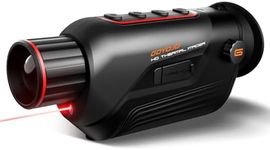
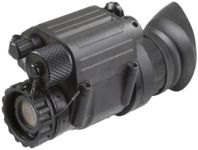
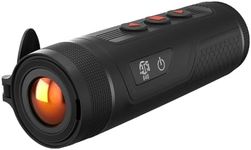
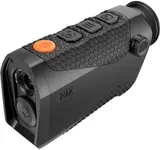
Buying Guide for the Best Night Vision Monocular
Choosing the right night-vision monocular can greatly enhance your nighttime viewing experience, whether you're using it for wildlife observation, security, or navigation. To make an informed decision, it's important to understand the key specifications and how they relate to your specific needs. Here are the main specs to consider when selecting a night-vision monocular.GenerationNight-vision monoculars are categorized into generations (Gen 1, Gen 2, Gen 3, and Gen 4), which indicate the technology and performance level. Gen 1 devices are the most affordable and suitable for casual use, offering basic night vision capabilities. Gen 2 provides better resolution and sensitivity, making it ideal for more serious users. Gen 3 and Gen 4 offer the highest performance with superior image quality and low-light sensitivity, suitable for professional and military applications. Choose a generation based on how often and in what conditions you plan to use the monocular.
MagnificationMagnification refers to how much closer the monocular can make distant objects appear. Lower magnification (1x to 3x) provides a wider field of view, which is useful for scanning large areas. Higher magnification (4x to 8x) allows you to see more detail at a distance but can narrow your field of view and may require a steadier hand or tripod. Consider your primary use: for general observation, lower magnification is often sufficient, while for detailed viewing at longer distances, higher magnification is preferable.
Objective Lens DiameterThe objective lens diameter, measured in millimeters, determines how much light the monocular can gather. Larger diameters (e.g., 40mm to 50mm) allow more light to enter, resulting in brighter and clearer images, especially in low-light conditions. However, larger lenses can make the monocular bulkier and heavier. If you need a compact and portable device, a smaller lens (e.g., 20mm to 30mm) might be more suitable, but for better image quality in very dark environments, opt for a larger lens.
ResolutionResolution indicates the clarity and detail of the image produced by the monocular. Higher resolution provides sharper and more detailed images, which is crucial for identifying objects and features. Resolution is often measured in line pairs per millimeter (lp/mm). For casual use, a lower resolution may be acceptable, but for tasks requiring precise identification, such as security or wildlife observation, a higher resolution is recommended.
Field of ViewField of view (FOV) is the width of the area visible through the monocular, usually measured in degrees or feet at a specific distance. A wider FOV allows you to see more of the surrounding area, which is beneficial for scanning and tracking moving objects. Narrower FOV provides a more focused view but limits the visible area. If you need to monitor large areas or follow fast-moving subjects, a wider FOV is advantageous. For detailed inspection of specific targets, a narrower FOV may suffice.
Infrared IlluminatorAn infrared (IR) illuminator is a built-in or attachable light source that emits infrared light, invisible to the naked eye but detectable by the monocular. This feature enhances visibility in complete darkness or very low-light conditions. Some monoculars come with adjustable IR illuminators, allowing you to control the intensity. If you plan to use the monocular in extremely dark environments, an IR illuminator is essential. For use in areas with some ambient light, it may be less critical.
Battery LifeBattery life indicates how long the monocular can operate on a single charge or set of batteries. Longer battery life is important for extended use, especially in remote areas where recharging or replacing batteries may not be convenient. Consider how long you typically need the device to last and whether you have access to spare batteries or charging options. For frequent or prolonged use, choose a monocular with longer battery life or the ability to use easily replaceable batteries.
Durability and Weather ResistanceDurability and weather resistance are important for ensuring the monocular can withstand harsh conditions and rough handling. Look for features like waterproofing, fog resistance, and shockproof construction. These are particularly important if you plan to use the monocular in challenging environments, such as during outdoor adventures or in inclement weather. For casual or indoor use, these features may be less critical, but they can still add to the overall longevity and reliability of the device.