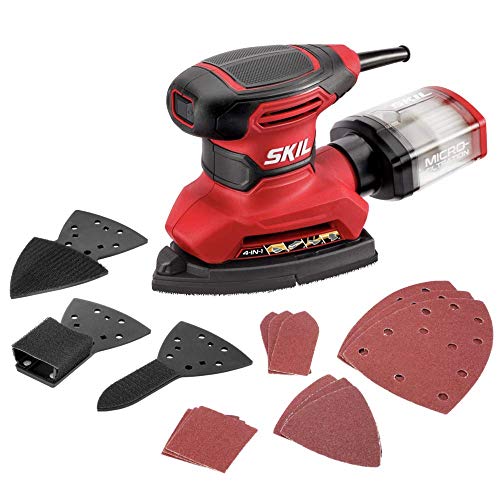
Buying Guide for the Best Mouse Sanders
When choosing a mouse sander, it's important to consider several key specifications to ensure you select the best tool for your needs. A mouse sander is a versatile tool used for sanding in tight spaces and detailed work. Understanding the different features and how they align with your specific requirements will help you make an informed decision.PowerPower in a mouse sander is measured in watts or amps and determines how efficiently the sander can remove material. Higher power means the sander can handle tougher materials and larger projects more easily. For light, detailed work or occasional use, a lower power sander (around 1-2 amps) may suffice. For more demanding tasks or frequent use, look for a sander with higher power (3 amps or more). Consider the type of projects you will be working on to decide the appropriate power level.
SpeedSpeed in a mouse sander is typically measured in orbits per minute (OPM). Higher speeds allow for faster material removal, while lower speeds offer more control for detailed work. Some sanders come with variable speed settings, which provide flexibility for different tasks. If you plan to use the sander for a variety of projects, a model with adjustable speed settings (ranging from 10,000 to 20,000 OPM) is ideal. For specific tasks like fine finishing, a lower speed setting may be more appropriate.
Dust CollectionDust collection is an important feature that helps keep your workspace clean and reduces airborne particles. Mouse sanders can come with built-in dust collection systems or ports for attaching external vacuum systems. A good dust collection system will improve visibility and reduce cleanup time. If you work in a small or enclosed space, or if you are concerned about dust, look for a sander with an efficient dust collection system. Models with a built-in dust bag or a port for a vacuum attachment are beneficial.
ErgonomicsErgonomics refers to how comfortable and easy the sander is to use. A well-designed mouse sander should fit comfortably in your hand and be easy to maneuver, especially for extended periods. Look for features like a soft-grip handle, lightweight design, and easy-to-reach controls. If you have smaller hands or plan to use the sander for long durations, prioritize models that emphasize ergonomic design to reduce fatigue and improve control.
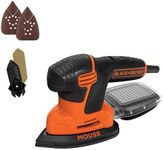
Pad Size and ShapeThe pad size and shape of a mouse sander affect its ability to reach tight spaces and perform detailed work. Mouse sanders typically have a triangular pad, which is ideal for getting into corners and along edges. The size of the pad can vary, with smaller pads offering more precision and larger pads covering more area quickly. Consider the type of projects you will be working on; for intricate, detailed work, a smaller pad may be more suitable, while for larger surfaces, a bigger pad can save time.
Ease of Sandpaper ChangeChanging sandpaper on a mouse sander should be quick and easy to minimize downtime. Most mouse sanders use a hook-and-loop (Velcro) system for attaching sandpaper, which allows for fast and secure changes. Some models may also have a clamping mechanism. If you anticipate changing sandpaper frequently, look for a sander with a user-friendly attachment system. This will make your work more efficient and less frustrating.