Buying Guide for the Best Miter Gauges
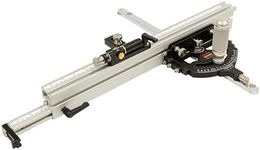
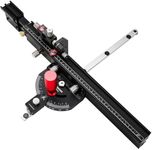
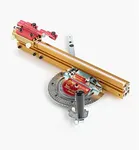
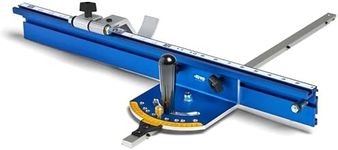
Choosing the right miter gauge is essential for achieving precise and accurate cuts in woodworking projects. A miter gauge is a tool used to hold workpieces at a specific angle while they are being cut on a table saw or band saw. To find the best miter gauge for your needs, it's important to understand the key specifications and how they impact performance. Here are the key specs to consider when selecting a miter gauge and how to navigate them to find the best fit for your projects.Angle RangeThe angle range of a miter gauge refers to the range of angles at which it can be set. This is important because it determines the versatility of the gauge in making various angled cuts. Most miter gauges offer a range from 0 to 45 degrees, but some can go up to 60 degrees or more. If you frequently work on projects that require a wide variety of angles, a miter gauge with a larger angle range would be beneficial. For general woodworking, a standard range of 0 to 45 degrees is usually sufficient.
AccuracyAccuracy is a critical spec for a miter gauge as it affects the precision of your cuts. This spec is important because even a small deviation can result in imperfect joints and misaligned pieces. Accuracy is often measured in degrees or fractions of a degree. High-precision miter gauges can be adjusted to within 0.1 degrees. If your projects demand high precision, such as in fine woodworking or cabinetry, opt for a miter gauge with high accuracy. For less critical projects, a standard accuracy of 0.5 degrees may be adequate.
Build QualityThe build quality of a miter gauge refers to the materials and construction used in its manufacture. This is important because a well-built miter gauge will be more durable and provide consistent performance over time. Miter gauges are typically made from materials like aluminum, steel, or cast iron. Aluminum is lightweight and resistant to rust, making it a good choice for portability. Steel and cast iron are heavier but offer greater stability and durability. Choose a build quality that matches the demands of your work environment and the frequency of use.
AdjustabilityAdjustability refers to the ease with which you can set and change the angles on the miter gauge. This is important for efficiency and convenience during use. Some miter gauges feature positive stops at common angles (e.g., 0, 15, 30, 45 degrees) which make it quick and easy to set the gauge to these angles. Others may have micro-adjustment features for fine-tuning the angle. If you need to make frequent adjustments or work with a variety of angles, look for a miter gauge with good adjustability features. For simpler projects, basic adjustability may suffice.
CompatibilityCompatibility refers to whether the miter gauge fits your specific table saw or band saw. This is important because not all miter gauges are universal, and some are designed to fit specific brands or models. Check the dimensions of the miter slot on your saw and ensure that the miter gauge you choose is compatible. Some miter gauges come with adjustable bars to fit different slot sizes. If you have multiple saws or plan to upgrade in the future, a universal miter gauge with adjustable features may be the best choice.
Additional FeaturesAdditional features can enhance the functionality and convenience of a miter gauge. These may include things like extension arms for supporting larger workpieces, flip stops for making repetitive cuts, or laser guides for improved accuracy. While these features are not essential, they can be very useful depending on the complexity and scale of your projects. Consider what additional features might benefit your workflow and choose a miter gauge that offers those enhancements.