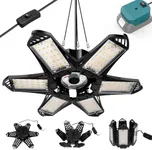
Buying Guide for the Best Makita Work Lights
When choosing a Makita work light, it's important to consider the specific needs of your work environment and tasks. Work lights are essential for providing adequate illumination in various settings, from construction sites to home workshops. The right work light can improve visibility, safety, and productivity. Here are some key specifications to consider when selecting a Makita work light and how to choose the best one for your needs.Brightness (Lumens)Brightness, measured in lumens, indicates how much light the work light emits. This is crucial because it determines how well you can see your work area. Lower lumens (under 500) are suitable for small, close-up tasks, while medium lumens (500-1500) are good for general work areas. High lumens (over 1500) are ideal for large or outdoor spaces. Choose a brightness level based on the size of your work area and the level of detail required for your tasks.
Battery LifeBattery life refers to how long the work light can operate on a single charge. This is important for ensuring that your light lasts through your work session without needing frequent recharges. Short battery life (under 4 hours) is fine for quick tasks, medium battery life (4-8 hours) is suitable for standard workdays, and long battery life (over 8 hours) is best for extended use or remote locations. Consider how long you typically work and whether you have access to charging facilities.
PortabilityPortability is about how easy it is to move the work light around. This includes the weight and design of the light. Lightweight and compact models are great for jobs that require frequent movement or for use in tight spaces. Heavier, more robust models are better for stationary use or rough environments. Think about whether you need to carry the light around often or if it will mostly stay in one place.
DurabilityDurability refers to how well the work light can withstand tough conditions, such as drops, dust, and water exposure. This is important for ensuring the longevity of the light, especially in harsh work environments. Basic durability is fine for indoor use, medium durability is suitable for occasional outdoor use, and high durability is necessary for heavy-duty or all-weather conditions. Assess the typical conditions of your work environment to determine the level of durability you need.
AdjustabilityAdjustability involves the ability to change the direction and angle of the light. This is important for directing light exactly where you need it. Fixed lights are suitable for general illumination, while adjustable lights are better for tasks that require focused lighting. Highly adjustable lights with multiple angles and positions are ideal for detailed work or when working in varied positions. Consider the type of tasks you perform and whether you need to frequently change the light's direction.
Power SourceThe power source of a work light can be either battery-operated or corded. Battery-operated lights offer greater mobility and are ideal for remote locations or areas without easy access to power outlets. Corded lights provide continuous power without the need for recharging but require access to an electrical outlet. Choose based on whether you need the flexibility to move around or if you have a stable power source available.