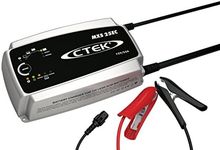
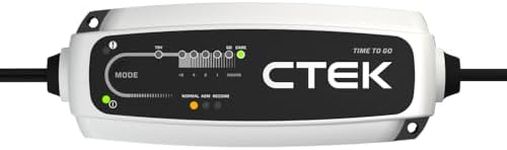
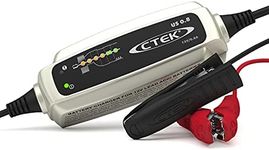
Buying Guide for the Best Ctek Battery Chargers
When choosing a CTEK battery charger, it's important to consider your specific needs and the type of battery you have. CTEK offers a range of chargers designed for different battery types and applications, so understanding the key specifications will help you make an informed decision. Here are the key specs to consider and how to navigate them to find the best fit for you.Battery Type CompatibilityBattery type compatibility refers to the types of batteries the charger can handle, such as lead-acid, AGM, gel, or lithium. This spec is crucial because using an incompatible charger can damage your battery. To navigate this, first identify the type of battery you have. If you have a lead-acid battery, look for a charger that supports it. For more specialized batteries like AGM or lithium, ensure the charger explicitly states compatibility. Choose a charger that matches your battery type to ensure safe and efficient charging.
Charging Current (Amps)Charging current, measured in amps, indicates how quickly the charger can charge your battery. This is important because a higher current can charge your battery faster, but it may not be suitable for all battery types. Chargers typically range from 0.8 amps to 25 amps. For small batteries or maintenance charging, a lower current (0.8-4 amps) is sufficient. For larger batteries or faster charging, look for higher currents (5-25 amps). Choose a current that matches your battery size and charging needs to avoid overcharging or undercharging.
VoltageVoltage refers to the electrical potential the charger provides, usually 6V or 12V for most automotive batteries. This spec is important because using the wrong voltage can damage your battery. To navigate this, check your battery's voltage rating. Most car batteries are 12V, while some smaller vehicles or equipment may use 6V. Choose a charger that matches your battery's voltage to ensure proper charging and avoid damage.
Charging ModesCharging modes refer to the different settings a charger offers, such as normal, maintenance, reconditioning, or winter mode. These modes are important because they allow you to tailor the charging process to your battery's needs. For example, maintenance mode is ideal for keeping a battery charged over long periods, while reconditioning mode can help revive a deeply discharged battery. To navigate this, consider how you plan to use the charger. If you need versatility, look for a charger with multiple modes. Choose modes that match your specific charging requirements to optimize battery health and performance.
Safety FeaturesSafety features include protections like reverse polarity, short circuit, and overcharge protection. These are important because they prevent damage to your battery and charger, and ensure safe operation. To navigate this, look for chargers that list multiple safety features. Choose a charger with comprehensive safety protections to safeguard your battery and provide peace of mind during charging.
Ease of UseEase of use refers to how user-friendly the charger is, including features like clear displays, simple controls, and easy connections. This is important because a charger that's difficult to use can lead to improper charging or frustration. To navigate this, consider your comfort level with technology. If you prefer simplicity, look for chargers with straightforward interfaces and clear instructions. Choose a charger that matches your comfort level to ensure a smooth and hassle-free charging experience.