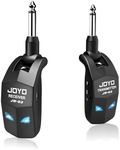
Buying Guide for the Best Cheap Wireless Guitar System
Choosing the right wireless guitar system can greatly enhance your performance by providing freedom of movement and eliminating the hassle of cables. When selecting a wireless guitar system, it's important to consider several key specifications to ensure you get the best fit for your needs. Understanding these specs will help you make an informed decision and find a system that suits your playing style and environment.Frequency RangeThe frequency range of a wireless guitar system determines the range of audio frequencies it can transmit. This is important because it affects the sound quality and clarity of your guitar's signal. Systems with a wider frequency range can capture more of the nuances in your playing. For most guitarists, a frequency range of 20Hz to 20kHz is sufficient, as it covers the full spectrum of human hearing. If you play genres that require a lot of low-end or high-end detail, look for a system with a broader range.
Operating RangeThe operating range is the maximum distance over which the wireless system can transmit a signal without losing quality. This is crucial for live performances where you may need to move around the stage. Short-range systems (up to 50 feet) are suitable for small venues or practice spaces, while medium-range systems (50-100 feet) are ideal for mid-sized venues. Long-range systems (over 100 feet) are best for large stages or outdoor performances. Consider the size of the venues you typically play in when choosing the operating range.
Battery LifeBattery life indicates how long the wireless system can operate on a single charge or set of batteries. This is important for ensuring that your system doesn't die in the middle of a performance. Systems with shorter battery life (up to 4 hours) are fine for short gigs or practice sessions, while those with medium battery life (4-8 hours) are better for longer performances. Systems with long battery life (over 8 hours) are ideal for extended use or multiple gigs without needing frequent recharges. Choose a system with a battery life that matches the length of your typical playing sessions.
LatencyLatency refers to the delay between when you play a note and when it is heard through the amplifier. Low latency is crucial for maintaining the timing and feel of your performance. High latency can be distracting and make it difficult to play in time with other musicians. Systems with latency under 5 milliseconds are considered low and are suitable for most players. If you are very sensitive to timing or play fast, intricate music, look for systems with the lowest possible latency.
Interference ResistanceInterference resistance is the system's ability to avoid signal disruption from other wireless devices or electronic equipment. This is important for maintaining a clear and consistent signal, especially in environments with many electronic devices. Systems with basic interference resistance are suitable for home use or small venues with minimal electronic interference. Systems with advanced interference resistance are better for larger venues or areas with many wireless devices. If you often play in busy or electronically dense environments, prioritize systems with strong interference resistance.
Build QualityBuild quality refers to the durability and robustness of the wireless system's components. This is important for ensuring the system can withstand the rigors of regular use and transportation. Systems with basic build quality are suitable for home use or occasional gigs. Systems with medium build quality are better for regular gigging musicians. Systems with high build quality are ideal for touring musicians who need equipment that can handle frequent travel and rough handling. Consider how often and in what conditions you will use the system when evaluating build quality.