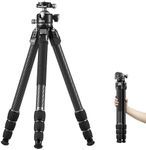
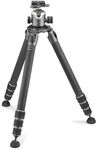
Buying Guide for the Best Carbon Fiber Travel Tripods
Choosing the right carbon-fiber travel tripod can significantly enhance your photography experience, especially when you're on the go. Carbon-fiber tripods are known for their lightweight and sturdy construction, making them ideal for travel. When selecting a tripod, it's important to consider several key specifications to ensure it meets your needs and preferences. Here are the main specs to look at and how to choose the best one for you.WeightWeight is a crucial factor for a travel tripod because you'll be carrying it around. Carbon-fiber tripods are generally lighter than their aluminum counterparts, which is why they are preferred for travel. The weight of a tripod can range from less than 1 kg to over 2 kg. If you plan to hike or walk long distances, a lighter tripod (under 1.5 kg) will be more comfortable to carry. However, if you need more stability for heavier camera equipment, you might opt for a slightly heavier model.
Load CapacityLoad capacity refers to the maximum weight the tripod can support. This is important to ensure your tripod can handle your camera and any additional equipment like lenses or flashes. Load capacities can range from 5 kg to over 20 kg. For most travel photography, a load capacity of around 8-10 kg is sufficient. If you use heavier professional equipment, look for a tripod with a higher load capacity to ensure stability and safety.
Folded LengthFolded length is the size of the tripod when it is fully collapsed. This is important for portability and ease of packing. Folded lengths can vary from around 30 cm to over 60 cm. If you need a tripod that fits easily into a backpack or carry-on luggage, look for one with a shorter folded length (under 45 cm). However, keep in mind that shorter folded lengths might mean more leg sections, which can affect stability and setup time.
Maximum HeightMaximum height is how tall the tripod can extend. This is important for getting the right shooting angle and comfort while using the camera. Maximum heights can range from around 100 cm to over 180 cm. If you prefer shooting at eye level, choose a tripod with a maximum height that matches your height. For more flexibility, a taller tripod can be beneficial, but it might also be heavier and bulkier.
Leg SectionsLeg sections refer to the number of segments each leg of the tripod has. More leg sections allow the tripod to collapse to a smaller size, but can also make it less stable and more time-consuming to set up. Tripods typically have between 3 to 5 leg sections. For travel, 4 or 5 leg sections are common as they offer a good balance between compactness and stability. If you prioritize quick setup and maximum stability, fewer leg sections (3 or 4) might be preferable.
Head TypeThe head type of a tripod determines how you can position and move your camera. Common types include ball heads, pan-tilt heads, and gimbal heads. Ball heads are popular for travel tripods because they are compact and allow for quick adjustments. Pan-tilt heads offer more precise control but are bulkier. Gimbal heads are ideal for heavy telephoto lenses but are usually not necessary for most travel photography. Choose a head type based on your shooting style and the type of photography you do.
StabilityStability is crucial for sharp, clear photos, especially in windy conditions or on uneven terrain. Carbon-fiber tripods are generally more stable than aluminum ones due to their rigidity. Look for features like rubber feet, spiked feet, or a hook for adding weight to increase stability. If you often shoot in challenging conditions, prioritize a tripod with excellent stability features. For casual travel photography, standard stability features should suffice.