Buying Guide for the Best Budget Fish Finder
Choosing the right fish finder can significantly enhance your fishing experience by helping you locate fish more efficiently. When selecting a fish finder, it's important to consider several key specifications that will determine how well the device meets your needs. Understanding these specs will help you make an informed decision and ensure you get the best value for your money.Display SizeThe display size of a fish finder is the size of the screen where you view the underwater images and data. A larger display size is important because it provides a clearer and more detailed view of the underwater environment, making it easier to spot fish and underwater structures. Display sizes typically range from 3 inches to over 10 inches. If you fish in larger bodies of water or need to see more detail, a larger display (7 inches or more) is ideal. For casual or occasional fishing in smaller areas, a smaller display (3-5 inches) may suffice.
ResolutionResolution refers to the number of pixels on the display screen. Higher resolution means more pixels, which translates to clearer and more detailed images. This is important for distinguishing between fish and other objects underwater. Resolutions can vary from 240 x 160 pixels to 1280 x 800 pixels or higher. If you need precise and detailed images, opt for a higher resolution. For general fishing purposes, a mid-range resolution should be adequate.
FrequencyFrequency in fish finders refers to the sonar waves emitted by the device to detect objects underwater. Common frequencies are 50 kHz, 83 kHz, 200 kHz, and higher. Lower frequencies (50 kHz) penetrate deeper into the water, making them suitable for deep-sea fishing. Higher frequencies (200 kHz) provide more detail and are better for shallow waters. If you fish in various depths, a dual-frequency or multi-frequency fish finder can offer versatility.
PowerPower in fish finders is measured in watts and determines how deep the sonar waves can penetrate. Higher power (measured in RMS watts) allows for better performance in deeper waters and clearer images. Power levels can range from 100 watts to over 1000 watts. If you fish in deep waters, a higher power fish finder is necessary. For shallow waters, lower power models are usually sufficient.
GPS CapabilitySome fish finders come with built-in GPS, which allows you to mark fishing spots, navigate, and track your location. This is particularly useful for finding your way back to productive fishing areas and for safety reasons. If you fish in unfamiliar or large bodies of water, a fish finder with GPS capability can be very beneficial. For small, familiar waters, GPS may not be as critical.
Transducer TypeThe transducer is the part of the fish finder that sends and receives sonar signals. Different transducers offer various features such as side imaging, down imaging, and CHIRP (Compressed High-Intensity Radiated Pulse) sonar. Side imaging provides a wide view of the area beside your boat, down imaging offers detailed images directly below, and CHIRP sonar provides clearer and more accurate readings. Choose a transducer type based on your fishing style and the type of water you fish in. For example, side imaging is great for scanning large areas, while down imaging is ideal for vertical fishing.
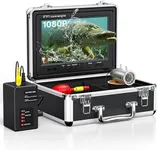



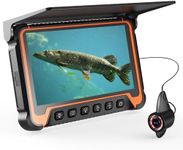
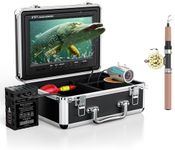

![[FishPRO®2025 Upgrade] [Auto-Focus 2''- 40''] Underwater Fishing Camera w/DVR 32GB,1200TVL, Ice Fishing Camera Underwater Fish Finder, w/IR+LED Light for Dark, 4500mAh w/ [Spare Charging Port], 49ft](https://images-proxy.bestreviews.guide/WnKlLKAWepHIBfamm6nAWbCrY2Y=/0x150/https://m.media-amazon.com/images/I/51hexOA1C9L._AC_CX679_.jpg)