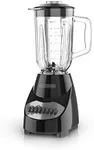
Buying Guide for the Best Blender With Glass Pitcher
Choosing the right blender with a glass pitcher can make a big difference in your kitchen experience. Blenders are versatile appliances that can help you make smoothies, soups, sauces, and more. When selecting a blender, it's important to consider several key specifications to ensure you get the best fit for your needs. Understanding these specs will help you make an informed decision and find a blender that meets your requirements and preferences.Power (Wattage)Power, measured in watts, determines the blender's ability to handle tough ingredients and blend them smoothly. Higher wattage means more power and efficiency. Blenders typically range from 300 to 1500 watts. For basic tasks like making smoothies or blending soft fruits, a blender with 300-600 watts is sufficient. For more demanding tasks like crushing ice or blending tough vegetables, look for a blender with 700-1000 watts. If you plan to use your blender frequently for heavy-duty tasks, consider a model with 1000 watts or more.
CapacityCapacity refers to the volume the glass pitcher can hold, usually measured in liters or cups. This is important because it determines how much you can blend at once. Blenders typically have capacities ranging from 1 to 2 liters. If you usually prepare small quantities or single servings, a smaller capacity (around 1 liter) will suffice. For larger families or if you like to prepare big batches, opt for a blender with a larger capacity (1.5 to 2 liters). Consider your typical usage to choose the right capacity for your needs.
Speed SettingsSpeed settings allow you to control the blending process and achieve different textures. Blenders can have anywhere from 2 to 10 or more speed settings. Basic blenders often have 2-3 speeds, which are adequate for simple tasks. More advanced models offer multiple speeds and even pre-programmed settings for specific tasks like smoothies, ice crushing, or soup making. If you need versatility and precision, look for a blender with a variety of speed options. For straightforward blending, fewer speed settings will do the job.
Blade Material and DesignThe blades are crucial for effective blending. They are typically made of stainless steel, which is durable and resistant to rust. The design and sharpness of the blades affect how well the blender can handle different ingredients. Some blenders have multi-tiered blades for better blending efficiency. If you plan to blend hard or fibrous ingredients, look for blenders with strong, sharp blades. For general use, standard stainless steel blades will work well. Consider the types of ingredients you will blend most often to choose the right blade design.
Ease of CleaningCleaning a blender can be a hassle, so it's important to consider how easy it is to clean. Some blenders have dishwasher-safe parts, which can save you time and effort. Others have self-cleaning functions where you add water and a drop of dish soap, then run the blender to clean it. If you prefer convenience, look for blenders with easy-to-clean features. For those who don't mind a bit of manual cleaning, ensure the blender's parts are easy to disassemble and reassemble.
Durability and Build QualityDurability and build quality are important for the longevity of your blender. A well-built blender with a sturdy glass pitcher and robust motor will last longer and perform better. Look for blenders with high-quality materials and solid construction. Reading reviews and checking the warranty can also give you an idea of the blender's durability. If you plan to use your blender frequently, investing in a durable model is worthwhile. For occasional use, a standard build quality should be sufficient.
Noise LevelBlenders can be quite noisy, which can be a concern if you have a quiet household or prefer to blend early in the morning or late at night. Noise levels vary between models, with some designed to operate more quietly. If noise is a concern for you, look for blenders that are specifically marketed as quiet or have noise-reducing features. For those who don't mind the noise, this may not be a significant factor. Consider your environment and preferences when evaluating noise levels.