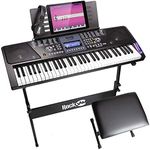
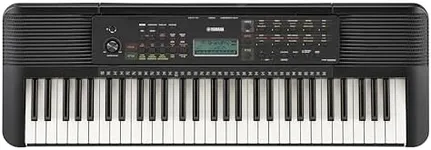
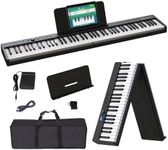
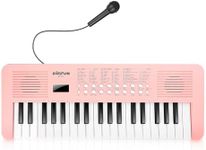
Buying Guide for the Best 61 Key Piano Keyboard
Choosing the right 61-key piano keyboard can be a rewarding experience if you know what to look for. A 61-key keyboard is a great option for beginners and intermediate players due to its compact size and versatility. When selecting a keyboard, consider the following key specifications to ensure you get the best fit for your needs.Key ActionKey action refers to how the keys respond when pressed. This is important because it affects the feel and playability of the keyboard. There are three main types: synth-action, semi-weighted, and fully-weighted. Synth-action keys are light and springy, making them easier to play quickly, which is great for beginners or those who play fast-paced music. Semi-weighted keys offer a balance between the lightness of synth-action and the resistance of fully-weighted keys, suitable for those who want a more piano-like feel without the full weight. Fully-weighted keys mimic the feel of an acoustic piano and are ideal for players who want to develop proper finger strength and technique. Choose the key action based on your playing style and what feels most comfortable to you.
Touch SensitivityTouch sensitivity means the keyboard responds to how hard or soft you press the keys, producing louder or softer sounds accordingly. This feature is important for expressive playing and dynamic control. Keyboards can have different levels of touch sensitivity, from none (fixed velocity) to multiple levels. For beginners, a keyboard with basic touch sensitivity is sufficient to start learning dynamics. Intermediate players might prefer a keyboard with more advanced touch sensitivity to better express their musical nuances. Consider your playing level and how much expressiveness you want in your music when choosing touch sensitivity.
Sound QualitySound quality is crucial as it determines how realistic and pleasing the keyboard sounds. This is influenced by the quality of the built-in speakers and the sound engine. Higher-end keyboards often have better sound engines and speakers, producing richer and more authentic sounds. For beginners, a keyboard with decent sound quality and a variety of instrument voices can be motivating and fun to play. Intermediate players might look for keyboards with more advanced sound engines and higher fidelity to better replicate the sound of an acoustic piano or other instruments. Test the sound quality in person if possible, and choose a keyboard that sounds good to your ears.
PolyphonyPolyphony refers to the number of notes a keyboard can produce at the same time. This is important for playing complex pieces and using the sustain pedal without notes cutting off. Keyboards typically range from 32 to 128-note polyphony. For beginners, 32 to 64-note polyphony is usually sufficient for most simple pieces and learning purposes. Intermediate players who play more complex music or use layering and sustain might prefer 64 to 128-note polyphony to ensure all notes are heard clearly. Consider the type of music you play and whether you use the sustain pedal when choosing the right polyphony.
PortabilityPortability is a key factor if you plan to move your keyboard frequently or have limited space. A 61-key keyboard is generally more portable than larger models, but weight and size can still vary. Lightweight keyboards are easier to transport and set up, making them ideal for students, gigging musicians, or those with limited space. Heavier keyboards might offer more features and better build quality but can be cumbersome to move. Consider how often you will need to move your keyboard and choose one that balances portability with the features you need.
ConnectivityConnectivity options determine how you can connect your keyboard to other devices, such as computers, tablets, or external speakers. Common connectivity options include USB, MIDI, and audio outputs. USB and MIDI connections are important for recording, using music software, or connecting to other MIDI-compatible instruments. Audio outputs allow you to connect to external speakers or amplifiers for better sound projection. Beginners might not need extensive connectivity options, but having USB or MIDI can be useful for learning apps and recording. Intermediate players who perform or record music might require more connectivity options to integrate with their setup. Consider your current and future needs when evaluating connectivity options.