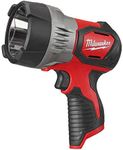
Buying Guide for the Best Milwaukee Flashlight
When choosing a Milwaukee flashlight, it's important to consider your specific needs and how you plan to use the flashlight. Milwaukee flashlights are known for their durability and high performance, making them a great choice for both professional and personal use. To ensure you pick the best model for you, focus on key specifications that will impact the flashlight's functionality and suitability for your tasks.LumensLumens measure the total amount of visible light emitted by the flashlight. This spec is important because it determines how bright the flashlight will be. Flashlights with lower lumens (under 100) are suitable for close-up tasks and general use around the house. Mid-range lumens (100-500) are good for outdoor activities like camping or hiking. High lumens (over 500) are ideal for professional use, search and rescue, or situations where you need a powerful beam. Choose the lumen level based on how bright you need the light to be for your specific tasks.
Beam DistanceBeam distance indicates how far the light can reach. This is important for activities where you need to see far ahead, such as hiking in the dark or inspecting large areas. Short beam distances (up to 50 meters) are sufficient for indoor use or close-up work. Medium beam distances (50-150 meters) are suitable for general outdoor use. Long beam distances (over 150 meters) are necessary for professional applications or when you need to see far into the distance. Consider the typical environment where you'll use the flashlight to determine the appropriate beam distance.
Battery LifeBattery life refers to how long the flashlight can operate on a single charge or set of batteries. This is crucial for ensuring the flashlight lasts as long as you need it to without frequent recharging or battery changes. Short battery life (under 5 hours) may be adequate for occasional use. Medium battery life (5-15 hours) is good for regular use. Long battery life (over 15 hours) is essential for extended use, such as during long trips or professional work. Think about how long you typically need the flashlight to run and choose a model with a suitable battery life.
DurabilityDurability refers to the flashlight's ability to withstand rough conditions, such as drops, water exposure, and extreme temperatures. This is important if you plan to use the flashlight in harsh environments. Basic durability features, like water resistance and impact resistance, are sufficient for general use. Enhanced durability, such as waterproof and shockproof ratings, are necessary for outdoor adventures or professional use. Consider the conditions in which you'll use the flashlight and choose a model with the appropriate level of durability.
Size and WeightSize and weight affect the portability and ease of use of the flashlight. This is important for comfort and convenience, especially if you need to carry the flashlight for extended periods. Compact and lightweight flashlights are ideal for everyday carry and quick tasks. Medium-sized flashlights offer a balance between portability and performance, suitable for general use. Larger and heavier flashlights provide more power and features but may be less convenient to carry. Think about how you'll carry and use the flashlight to determine the best size and weight for your needs.
Modes and FeaturesModes and features refer to the different settings and functionalities the flashlight offers, such as adjustable brightness levels, strobe mode, and SOS signals. These are important for versatility and adapting the flashlight to different situations. Basic models may have a single mode, which is sufficient for simple tasks. Flashlights with multiple modes offer more flexibility, allowing you to adjust the brightness or use special features as needed. Consider what additional features might be useful for your specific needs and choose a model that offers those options.