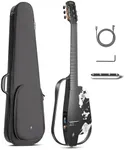
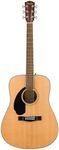
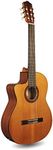
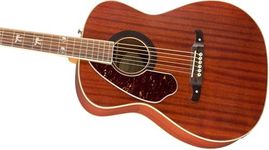
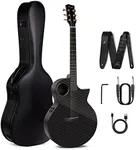
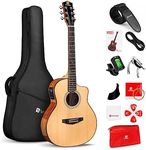
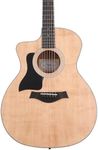
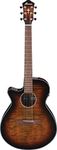
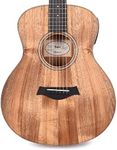
Buying Guide for the Best Left Handed Acoustic Guitars
Choosing the right left-handed acoustic guitar can be a rewarding experience, but it requires some careful consideration. The key is to understand the various specifications and how they align with your personal needs and playing style. By focusing on the right features, you can find a guitar that not only feels comfortable but also sounds great and suits your musical preferences.Body ShapeThe body shape of an acoustic guitar affects both its sound and playability. Common shapes include dreadnought, concert, and jumbo. Dreadnoughts are known for their powerful, balanced sound and are great for strumming and flat-picking. Concert guitars are smaller and more comfortable to hold, making them ideal for fingerpicking and lighter playing styles. Jumbo guitars have a larger body, producing a louder and bass-heavy sound, suitable for players who want a big, bold tone. Choose a body shape that feels comfortable to hold and suits your playing style.
TonewoodTonewood refers to the type of wood used in the construction of the guitar, which significantly influences its sound. Common tonewoods include spruce, mahogany, and rosewood. Spruce is a popular choice for the top of the guitar due to its bright and clear tone. Mahogany offers a warmer, more mid-range focused sound, while rosewood provides a rich, complex tone with strong bass and treble. Consider the type of music you play and the sound you prefer when selecting the tonewood.
Neck ProfileThe neck profile describes the shape and thickness of the guitar's neck, which affects how it feels in your hand. Common profiles include C-shaped, V-shaped, and U-shaped. A C-shaped neck is rounded and comfortable for most players, making it a versatile choice. V-shaped necks have a more pronounced ridge, which some players find easier for thumb-over playing styles. U-shaped necks are thicker and can provide a more substantial grip, suitable for players with larger hands. Choose a neck profile that feels comfortable and suits your hand size and playing technique.
Scale LengthScale length is the distance between the nut and the saddle of the guitar, affecting string tension and playability. Common scale lengths range from 24.75 inches to 25.5 inches. A shorter scale length (around 24.75 inches) results in lower string tension, making the guitar easier to play and bend notes. A longer scale length (around 25.5 inches) provides more string tension, which can result in a brighter tone and better note definition. Consider your playing style and comfort when choosing the scale length.
Nut WidthNut width is the width of the guitar's neck at the nut, affecting string spacing and playability. Common nut widths range from 1.65 inches to 1.75 inches. A narrower nut width (around 1.65 inches) makes it easier to reach across the fretboard, which can be beneficial for players with smaller hands or those who play a lot of chords. A wider nut width (around 1.75 inches) provides more space between the strings, which can be helpful for fingerstyle playing and players with larger hands. Choose a nut width that feels comfortable and suits your playing style.
ElectronicsSome acoustic guitars come with built-in electronics, allowing you to amplify your sound for live performances or recording. These systems typically include a pickup and a preamp with controls for volume and tone. If you plan to perform live or record your music, having built-in electronics can be very convenient. However, if you primarily play acoustically at home, you may not need this feature. Consider your playing environment and whether you need the ability to amplify your guitar when deciding on electronics.