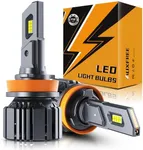
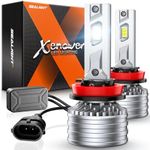
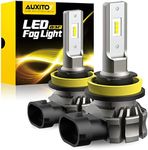
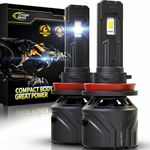
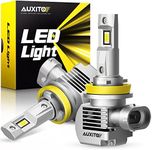
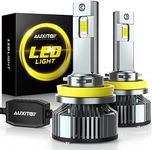
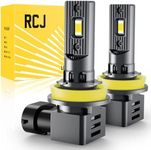
Buying Guide for the Best H11 Led Headlight Bulbs
Choosing the right H11 LED headlight bulbs can significantly improve your driving experience by providing better visibility and safety. When selecting the best fit for your vehicle, it's important to consider several key specifications to ensure you get the optimal performance and longevity from your headlights. Understanding these specs will help you make an informed decision that matches your driving needs and conditions.Brightness (Lumens)Brightness, measured in lumens, indicates how much light the bulb emits. This is crucial for visibility, especially during night driving or in poor weather conditions. Lower lumens (around 6,000-8,000) are suitable for city driving with well-lit streets. Medium lumens (8,000-10,000) are ideal for suburban areas with moderate lighting. Higher lumens (10,000-12,000 or more) are best for rural or off-road driving where lighting is minimal. Choose the brightness level based on your typical driving environment to ensure you have adequate visibility without blinding other drivers.
Color Temperature (Kelvin)Color temperature, measured in Kelvin (K), determines the color of the light emitted by the bulb. This affects how well you can see and how comfortable the light is for your eyes. Lower color temperatures (3,000K-4,000K) produce a warm, yellowish light, which is easier on the eyes but may not provide the best visibility. Mid-range temperatures (5,000K-6,000K) emit a bright white light, offering a good balance of visibility and comfort. Higher temperatures (6,000K-7,000K or more) produce a bluish-white light, which can enhance contrast but may cause more glare. Select a color temperature that provides clear visibility without causing eye strain.
Lifespan (Hours)The lifespan of an LED headlight bulb, measured in hours, indicates how long the bulb is expected to last before it needs replacement. This is important for maintenance and cost-effectiveness. Shorter lifespans (up to 20,000 hours) may be sufficient for occasional drivers. Medium lifespans (20,000-30,000 hours) are suitable for regular daily driving. Longer lifespans (30,000 hours or more) are ideal for heavy or professional drivers who spend a lot of time on the road. Consider how often you drive and how much maintenance you are willing to perform when choosing the lifespan of your bulbs.
Beam PatternThe beam pattern of an LED headlight bulb affects how the light is distributed on the road. A well-designed beam pattern ensures that the light is focused where you need it without causing glare to oncoming traffic. Standard beam patterns are suitable for general driving conditions. Wide beam patterns provide better peripheral visibility, which is useful for rural or off-road driving. Focused beam patterns offer a longer reach, ideal for highway driving. Choose a beam pattern that matches your driving habits and the typical conditions you encounter.
CompatibilityCompatibility refers to whether the LED headlight bulbs fit your vehicle's make and model. This is crucial to ensure proper installation and function. Check your vehicle's manual or consult with a professional to determine the correct bulb size and type. Some bulbs are designed to be plug-and-play, making installation easier, while others may require additional modifications or adapters. Ensure the bulbs you choose are compatible with your vehicle to avoid installation issues and ensure optimal performance.
Cooling MechanismLED headlight bulbs generate heat, and a good cooling mechanism is essential to maintain performance and longevity. There are two main types of cooling mechanisms: fan-based and fanless. Fan-based cooling uses a small fan to dissipate heat, which is effective but can be noisy and prone to failure. Fanless cooling uses heat sinks or other passive methods, which are quieter and more reliable but may not be as effective in extreme conditions. Consider your driving environment and preference for noise when choosing the cooling mechanism for your bulbs.