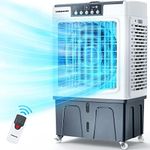
Buying Guide for the Best Evaporative Air Coolers
Evaporative air coolers, also known as swamp coolers, are a cost-effective and eco-friendly way to cool your home or office. They work by evaporating water to cool the air, making them ideal for dry climates. When choosing an evaporative air cooler, it's important to consider several key specifications to ensure you select the best model for your needs. Understanding these specs will help you make an informed decision and get the most out of your purchase.Cooling CapacityCooling capacity, often measured in cubic feet per minute (CFM), indicates how much air the cooler can process and cool. This is crucial because it determines the size of the area the cooler can effectively cool. For small rooms or personal use, a cooler with a lower CFM (up to 500) is sufficient. For medium-sized rooms, look for a CFM between 500 and 1000. For large spaces or multiple rooms, you will need a cooler with a CFM above 1000. Choose a model that matches the size of the area you want to cool to ensure optimal performance.
Water Tank CapacityThe water tank capacity indicates how much water the cooler can hold, which affects how long it can run before needing a refill. This is important for convenience and continuous operation. Small tanks (up to 5 gallons) are suitable for personal or short-term use. Medium tanks (5-10 gallons) are good for regular home use. Large tanks (over 10 gallons) are ideal for extended use or larger areas. Consider how often you are willing to refill the tank and the duration you need the cooler to run when choosing the right capacity.
Airflow ControlAirflow control features, such as adjustable louvers and multiple fan speeds, allow you to direct and control the flow of air to where it's needed most. This is important for comfort and efficiency. Basic models may have fixed louvers and a single speed, which are suitable for small, specific areas. Mid-range models often offer adjustable louvers and multiple speeds, providing more flexibility for different room sizes and cooling needs. High-end models may include oscillating louvers and a wide range of speeds for maximum control and coverage. Choose a model with airflow control features that match your comfort preferences and room layout.
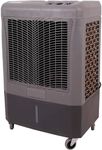
PortabilityPortability refers to how easy it is to move the cooler from one place to another. This is important if you plan to use the cooler in different rooms or locations. Lightweight models with built-in handles and caster wheels are easy to move and are ideal for versatile use. Heavier models may be more powerful but less convenient to relocate. Consider your need for mobility and choose a model that you can easily transport to where you need cooling.
Energy EfficiencyEnergy efficiency indicates how much power the cooler uses relative to its cooling output. This is important for reducing electricity costs and environmental impact. Look for models with energy-saving features such as variable speed settings, timers, and eco modes. More efficient models will have lower wattage and still provide effective cooling. Choose a model that balances energy consumption with your cooling needs to save on energy bills and reduce your carbon footprint.
Noise LevelNoise level, measured in decibels (dB), indicates how loud the cooler is during operation. This is important for maintaining a comfortable and quiet environment, especially in bedrooms or offices. Low-noise models (below 50 dB) are ideal for quiet settings. Moderate noise levels (50-60 dB) are acceptable for living rooms or areas with background noise. High-noise models (above 60 dB) may be suitable for outdoor use or large, noisy spaces. Consider where you will use the cooler and choose a model with an appropriate noise level for that environment.