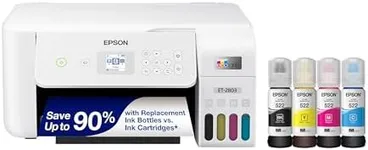
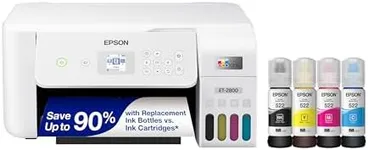
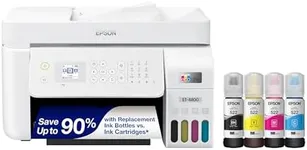
Buying Guide for the Best Epson Et Printers
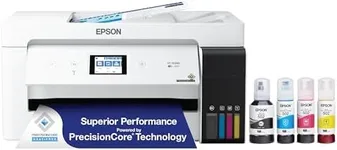
Choosing the right Epson EcoTank (ET) printer involves understanding your specific needs and matching them with the printer's features. EcoTank printers are known for their high-capacity ink tanks, which can save you money in the long run. However, there are various models with different capabilities, so it's important to consider what you'll be using the printer for, such as home use, office work, or photo printing. Here are some key specifications to consider when selecting an Epson ET printer.Print SpeedPrint speed is measured in pages per minute (ppm) and indicates how quickly a printer can produce documents. This is important if you need to print large volumes of documents regularly. For occasional home use, a lower print speed (around 10-15 ppm) might be sufficient. For office environments or heavy use, look for higher speeds (20 ppm or more) to ensure efficiency.
Print QualityPrint quality is measured in dots per inch (dpi) and determines the clarity and detail of the printed output. Higher dpi values result in sharper and more detailed prints. For general document printing, 600 x 600 dpi is usually adequate. If you need to print high-quality photos or detailed graphics, look for printers with 1200 x 2400 dpi or higher.
Ink Tank CapacityInk tank capacity refers to the amount of ink the printer can hold, which affects how often you need to refill it. Larger tanks are beneficial for high-volume printing as they reduce the frequency of refills. Consider your printing volume: for occasional use, smaller tanks may be sufficient, but for frequent or heavy printing, larger tanks will be more convenient and cost-effective.
Connectivity OptionsConnectivity options include USB, Wi-Fi, Ethernet, and sometimes Bluetooth. These determine how you can connect your devices to the printer. For home use, Wi-Fi connectivity is often sufficient and allows for wireless printing from multiple devices. In an office setting, Ethernet connectivity might be preferred for a stable and secure connection. USB connections are standard and reliable for direct printing.
Paper HandlingPaper handling capabilities include the types and sizes of paper the printer can accommodate, as well as the capacity of the paper tray. If you need to print on various media types (like envelopes, labels, or photo paper), ensure the printer supports them. For high-volume printing, a larger paper tray capacity (250 sheets or more) will reduce the need for frequent refilling.
Duplex PrintingDuplex printing allows the printer to print on both sides of the paper automatically. This feature is important for saving paper and is particularly useful in office environments where large documents are printed regularly. If you frequently print double-sided documents, look for a printer with automatic duplex printing. For occasional use, manual duplex printing might be sufficient.
Scanner and Copier FunctionsMany Epson ET printers come with built-in scanners and copiers. The resolution of the scanner (measured in dpi) affects the quality of scanned images. For basic scanning and copying needs, a resolution of 600 x 1200 dpi is usually adequate. If you need to scan high-quality images or detailed documents, look for higher resolutions. Consider if you need additional features like an automatic document feeder (ADF) for scanning multiple pages quickly.
Operating CostsOperating costs include the price of ink refills and maintenance. Epson ET printers are designed to be cost-effective with their high-capacity ink tanks, but it's still important to consider the cost of replacement ink bottles. Check the estimated cost per page to understand the long-term expenses. If you print frequently, a model with lower operating costs will be more economical in the long run.