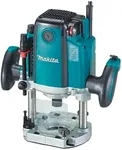
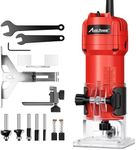
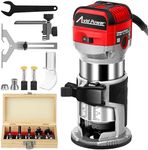
Buying Guide for the Best Corded Routers
When choosing a corded router, it's important to consider your specific needs and the types of projects you'll be working on. Corded routers are powerful tools used for woodworking, and they come in various types and sizes. Understanding the key specifications will help you select the best router for your tasks, ensuring efficiency and precision in your work.Power (Amps)The power of a corded router is measured in amps, and it determines how much force the router can apply to the material. Higher power (10-15 amps) is suitable for heavy-duty tasks and harder materials, while lower power (5-9 amps) is adequate for lighter tasks and softer woods. Choose a router with power that matches the intensity and frequency of your projects.
Speed (RPM)Speed, measured in revolutions per minute (RPM), indicates how fast the router bit spins. Variable speed routers allow you to adjust the RPM to match the material and bit size, providing better control and finish. For general use, a speed range of 8,000 to 25,000 RPM is common. If you work with a variety of materials, a router with adjustable speed settings is ideal.
Collet SizeThe collet size determines the diameter of the router bits you can use. Common sizes are 1/4 inch and 1/2 inch. A 1/2 inch collet can handle larger bits and is more stable, making it suitable for heavy-duty tasks. A 1/4 inch collet is lighter and easier to handle, ideal for detailed work. Consider the type of bits you plan to use and choose a router with the appropriate collet size.
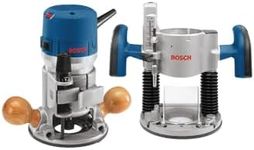
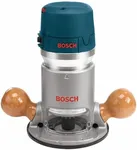
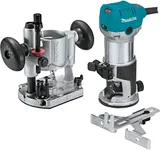
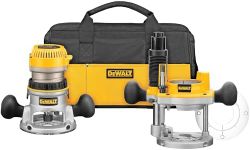
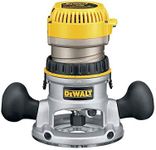
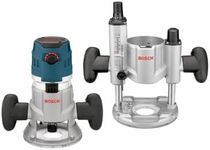
Base TypeRouters come with different base types: fixed, plunge, and interchangeable. A fixed base router is stable and precise, suitable for edge work and straight cuts. A plunge base allows you to start cutting in the middle of a workpiece, ideal for intricate designs and inlays. Interchangeable bases offer versatility, allowing you to switch between fixed and plunge bases as needed. Choose the base type based on the nature of your projects.
ErgonomicsErgonomics refers to the design and comfort of the router. A well-designed router with comfortable grips and balanced weight reduces fatigue and increases control during use. Look for features like soft-grip handles, easy-to-reach controls, and a balanced design. If you plan to use the router for extended periods, ergonomics should be a key consideration.
Dust CollectionDust collection is an important feature that helps keep your workspace clean and improves visibility while working. Some routers come with built-in dust collection systems or ports that can be connected to a vacuum. Effective dust collection is especially important if you work indoors or in a small workshop. Consider a router with good dust collection capabilities to maintain a clean and safe working environment.