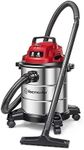
Buying Guide for the Best 5-Gallon Shop-Vacs
When it comes to picking a 5-gallon shop vac, it's important to consider your specific needs and the tasks you plan to tackle. Shop vacs are versatile tools that can handle a variety of cleaning jobs, from sucking up sawdust in a workshop to dealing with water spills in a basement. Understanding the key specifications will help you choose the best model for your requirements.Power (Horsepower or Amps)The power of a shop vac is usually measured in horsepower (HP) or amps. This spec indicates the strength of the motor and its ability to create suction. Higher horsepower or amps mean more powerful suction, which is important for heavy-duty cleaning tasks. For light to moderate use, such as cleaning a car or small workshop, a shop vac with 1.5 to 2.5 HP or around 6-8 amps should suffice. For more demanding tasks, like construction site cleanup or large debris, look for models with 3 HP or more, or 9-12 amps.
Airflow (CFM)Airflow, measured in cubic feet per minute (CFM), indicates how much air the vacuum can move. This is crucial for determining how quickly and efficiently the vac can pick up debris. Higher CFM values mean better performance, especially for fine dust and small particles. For general use, a CFM of 70-90 is adequate. For more intensive cleaning, such as dealing with large amounts of sawdust or water, aim for a CFM of 100 or higher.
Sealed Pressure (Inches of Water Lift)Sealed pressure, measured in inches of water lift, shows the vacuum's ability to lift water vertically. This is particularly important for wet vacuuming tasks. Higher water lift values mean the vac can handle heavier, denser materials and liquids. For basic wet/dry tasks, a water lift of 50-70 inches is sufficient. For more challenging wet cleanups, look for a water lift of 80 inches or more.
Tank MaterialThe tank material of a shop vac can be either plastic or stainless steel. Plastic tanks are lightweight and resistant to dents and corrosion, making them suitable for general use and easier to maneuver. Stainless steel tanks are more durable and can handle rougher conditions, making them ideal for heavy-duty tasks. Choose plastic for lighter, everyday tasks and stainless steel for more demanding environments.
Filtration SystemThe filtration system in a shop vac is crucial for maintaining air quality and preventing dust from being released back into the environment. Basic models come with standard filters that are suitable for general debris. For finer particles, such as drywall dust or allergens, look for HEPA filters or models with multiple stages of filtration. If you have allergies or are working in a sensitive environment, a high-quality filtration system is essential.
Portability and ManeuverabilityPortability and maneuverability are important factors, especially if you need to move the shop vac around frequently. Consider the weight of the unit and whether it has wheels or a handle for easy transport. Lighter models with sturdy wheels and ergonomic handles are ideal for frequent movement. If you plan to keep the vac in one place, portability may be less of a concern.
Noise LevelShop vacs can be quite loud, so considering the noise level is important, especially if you will be using it in a residential area or for extended periods. Noise levels are measured in decibels (dB). Quieter models typically operate at around 60-70 dB, while more powerful units can reach 80 dB or higher. If noise is a concern, look for models with noise-reduction features or lower dB ratings.
Accessories and AttachmentsThe range of accessories and attachments that come with a shop vac can greatly enhance its versatility. Common attachments include crevice tools, extension wands, and brush nozzles. Consider what tasks you will be performing and choose a model that includes the necessary accessories. For example, if you need to clean tight spaces or upholstery, look for a vac with a variety of nozzles and brushes.